
Trademarks & Naming Risk
Domain Name vs Trademark: What You Need to Know
Owning a domain does not automatically give you trademark rights. Learn how domain registration and trademark protection differ before committing to a name.
July 20, 2026 -
9 min read
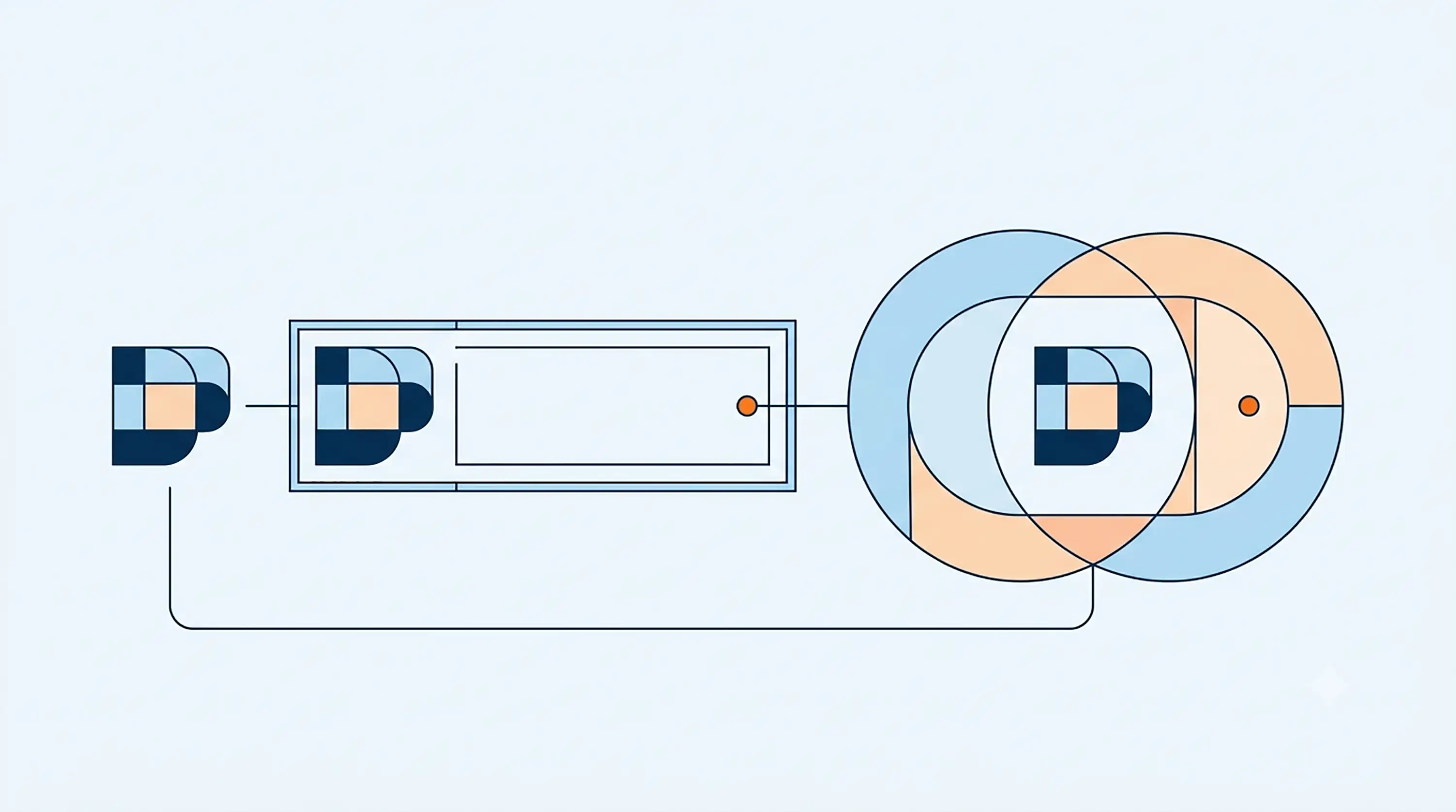
A domain name and a trademark can contain exactly the same words. They do not provide the same rights.
A domain gives you control of a specific internet address. A trademark identifies the commercial source of particular goods or services and may give its owner legal rights within defined markets and territories. Registering one does not automatically secure the other.
This distinction matters before you:
- choose a company name;
- buy a premium domain;
- invest in branding;
- launch a product;
- enter a new country;
- apply for trademark registration.
A clean domain can be an excellent brand asset. It is not evidence that the name is legally clear for your intended use.
A domain name and a trademark solve different problems
The simplest way to understand the difference is to look at what each asset does.
| Comparison | Domain name | Trademark |
|---|---|---|
| Main purpose | Identifies an internet address | Identifies the commercial source of goods or services |
| Obtained through | A domain registrar or marketplace | Use, registration, or both, depending on the jurisdiction |
| Scope | One exact domain and extension | Particular signs, goods or services, and territories |
| Main benefit | Control of the web address | Brand identification and legal protection |
| Automatic relationship | Does not create trademark rights | Does not automatically give control of the matching domain |
A domain may be:
example.com
A trademark may protect:
EXAMPLE
for particular products or services in particular jurisdictions.
The matching words can create a strong naming system, but the two assets remain legally and operationally separate.
What does owning a domain name give you?
Registering or buying a domain normally gives you the contractual right to control that web address while the registration remains active and the applicable terms are followed.
You can typically use the domain for:
- a website;
- email addresses;
- redirects;
- landing pages;
- online services;
- future projects.
The domain is registered through an accredited registrar rather than through a trademark office. The exact combination is unique: only one registrant can control a particular domain such as example.com at one time.
However, ownership of the domain does not automatically mean:
- you own the word in every commercial context;
- no similar businesses already use the name;
- the name is available as a trademark;
- you can use it for any product in any country;
- another party cannot challenge the registration.
The USPTO states explicitly that registering a domain does not create trademark rights. It also notes that a registrant may later have to surrender a domain if its use infringes another party’s trademark rights.
A domain is therefore an important digital asset, but it is not legal clearance for the underlying name.
What does a trademark protect?
A trademark is a sign that helps customers identify the source of goods or services and distinguish one business from another.
It may consist of:
- a word;
- a business or product name;
- a phrase;
- a logo;
- a symbol;
- a design;
- a combination of these elements.
Trademark rights are connected to commercial identity. They do not normally grant unlimited ownership of a word in every possible use. Their scope depends on factors such as the goods or services involved, the territory, the similarity between signs, and the likelihood that customers could be confused.
For example, the same or a similar name may potentially be used by businesses operating in unrelated sectors when customers are unlikely to believe that the businesses are connected.
That does not mean identical names are always safe in different categories. The assessment can become more complex when:
- the goods or services are related;
- the names look or sound similar;
- the audiences overlap;
- one brand is particularly well known;
- the later use appears to trade on another brand’s reputation.
A trademark is also territorial. Protection generally applies in the countries or regions where rights have been established or registered. There is no single registration that automatically creates unrestricted worldwide protection.
Domain availability is not trademark availability
A domain may be available because nobody has registered that exact web address.
That tells you very little about whether the underlying name is free for commercial use.
A similar or identical trademark may already exist:
- under another domain extension;
- without a corresponding website;
- in a different country;
- as a product rather than a company;
- with a slightly different spelling;
- as an unregistered mark recognised under local law;
- within a related category of goods or services.
The reverse is also possible. A trademark may be available to register even though someone else owns the matching .com.
The two checks answer different questions:
Domain search: Can you acquire this exact internet address?
Trademark search: Can you use and potentially protect this sign for your intended goods or services in the relevant territory?
A “yes” to one question is not a “yes” to the other.
Similarity matters more than an exact match
Founders often search only for the exact spelling of a name.
That is not enough.
Trademark conflicts can involve names that are similar in:
- appearance;
- pronunciation;
- meaning;
- structure;
- overall commercial impression.
The relevant assessment also considers whether the associated goods or services are related. Even when two marks are similar, the likelihood-of-confusion analysis depends partly on the relationship between the goods or services.
Suppose you are considering:
Velora
An exact search for Velora is useful, but you may also need to review expressions such as:
VelloraVelorraBeloraVeloro
The objective is not to prove that every vaguely similar word creates a conflict.
It is to identify earlier rights that could make customers believe the businesses, products, or services come from the same source.
That evaluation is rarely completed by one exact-match search.
Can two companies use the same name?
Sometimes, but the answer depends on context.
Trademark rights are tied to particular goods or services and territories. Two businesses may therefore coexist under the same or similar names when they operate in sufficiently different markets and customers are unlikely to confuse them.
For example, a name used for specialist industrial machinery may create a different commercial context from the same name used for a local restaurant.
The situation becomes riskier when the businesses:
- sell related products;
- address similar audiences;
- operate in the same territory;
- use similar visual identities;
- distribute through the same channels;
- could reasonably be assumed to be connected.
Trademark classification helps organise goods and services, but different class numbers do not automatically remove the possibility of a conflict. Related products or services can sometimes fall into different classes, while unrelated items can appear within the same class.
The assessment should focus on the actual commercial relationship, not only on the class number.
Buying the domain first can create unnecessary risk
A strong domain may feel too valuable to leave available while you investigate the name.
There are situations where acquiring it early is commercially reasonable. But buying the domain should not be confused with approving the brand.
The risk increases when you immediately invest in:
- logo design;
- packaging;
- website development;
- product manufacturing;
- advertising;
- company registration;
- international launch activity.
If a serious trademark conflict later appears, the cost is not limited to the domain purchase. You may need to change the name across the entire business.
A safer approach is to separate the decisions:
- Secure the domain when appropriate.
- Treat the acquisition as confidential and provisional.
- Complete the relevant name and trademark checks.
- Confirm the brand before a public launch.
This does not eliminate every risk, but it prevents domain ownership from creating false confidence.
Can a trademark owner take a domain name?
Not automatically.
Trademark ownership does not give someone an immediate right to every domain containing the mark. The circumstances of the registration and use matter.
For many generic top-level domains, including .com, trademark-related disputes involving alleged abusive registration may be handled under ICANN’s Uniform Domain-Name Dispute-Resolution Policy, commonly known as the UDRP.
The procedure is intended primarily for claims involving abusive, bad-faith domain registrations, such as cybersquatting. Other disputes may require negotiation or court proceedings.
A dispute may examine issues such as whether:
- the domain is identical or confusingly similar to a mark;
- the registrant has rights or legitimate interests in the name;
- the domain was registered and used in bad faith.
Legitimate ownership and use can matter. Registering a descriptive word for a genuine unrelated project is different from registering a distinctive existing brand to mislead customers or demand payment from the brand owner.
Because domain disputes can involve legal and procedural complexity, specific cases should be assessed by a qualified professional.
How to check a name before committing
Trademark clearance is not a single search. It is a structured review.
1. Define how you will use the name
Start by identifying:
- the company or product using it;
- the goods or services involved;
- the intended audience;
- the countries where you will operate;
- likely future expansion.
A name may present little risk for one type of service and greater risk for another.
2. Search the exact name
Check:
- search engines;
- business directories;
- app stores;
- domain registrations;
- social platforms;
- relevant industry publications.
This helps identify existing commercial use that may not appear immediately in a trademark database.
3. Search similar names
Review:
- alternative spellings;
- phonetic equivalents;
- singular and plural forms;
- spacing variations;
- translated meanings;
- related word structures.
The EUIPO and USPTO both recommend searching for earlier identical and similar trademarks before applying. Likelihood of confusion, not only exact duplication, is a central concern.
4. Check official trademark databases
Depending on the target markets, useful official resources include:
- TMview for participating national, EU, and international offices;
- EUIPO eSearch for European Union trademarks;
- WIPO Global Brand Database for multiple international and national collections;
- USPTO Trademark Search for US applications and registrations;
- national intellectual property office databases, such as INPI in Portugal.
No single database necessarily covers every relevant right. You may also need to search the registers of national or regional offices.
5. Review the goods, services, and territory
Do not stop when you find a similar name.
Check:
- who owns it;
- whether it is active;
- the territories covered;
- the goods and services listed;
- the date of application or registration;
- how the mark is actually used;
- whether the commercial fields overlap.
The result may be irrelevant, clearly problematic, or somewhere between the two.
6. Obtain professional advice when the stakes are significant
Professional clearance becomes especially important when:
- the launch involves substantial investment;
- the name is close to an existing brand;
- several countries are involved;
- the business operates in a regulated or crowded sector;
- investors or commercial partners require certainty;
- the search results are difficult to interpret.
A lawyer or qualified trademark professional can assess issues that a basic database search cannot resolve reliably.
Common misconceptions
“I own the .com, so I own the name”
You control the domain, not every commercial use of the underlying expression.
“The company registry accepted the name, so the trademark is clear”
Company-name registration and trademark clearance are separate processes. Acceptance by a business registry does not necessarily confirm that the name is safe as a brand.
“There is no exact trademark, so there is no risk”
Similar spelling, sound, meaning, and related goods or services may still create a potential conflict.
“The other company is in another class, so it cannot object”
Trademark classes organise goods and services. They do not replace the broader assessment of commercial similarity and possible confusion.
“A trademark registration gives worldwide ownership”
Trademark rights are territorial and connected to defined goods or services. Protection must be considered market by market.
“Buying a premium domain means the seller has cleared the trademark”
A domain seller is transferring the domain asset. Unless explicitly stated otherwise, the buyer remains responsible for evaluating whether the name is suitable and legally available for the intended use.
Use the domain and trademark as complementary assets
The strongest naming systems often align several elements:
- business name;
- product name;
- trademark rights;
- primary domain;
- email addresses;
- social handles;
- visual identity.
A matching .com can improve clarity and consistency. A trademark can support the legal protection of the commercial identity.
Neither replaces the other.
Before committing to a name, ask:
- Can people pronounce and remember it?
- Is the right domain available or acquirable?
- Are similar businesses already using it?
- Have exact and similar trademarks been searched?
- Do the goods, services, and territories overlap?
- Can the business use the name consistently?
- Is professional clearance appropriate?
- Does the name still support the company’s future plans?
The objective is not to remove all uncertainty. No preliminary search can guarantee that a dispute will never arise.
The objective is to identify avoidable risks before the company invests heavily in a name it may not be able to use.
A domain secures the address. A trademark protects the identity.
A domain name answers:
“Where can people find this business online?”
A trademark answers:
“Which business is the commercial source of these goods or services?”
A strong brand may need both.
Buying the domain can secure an important digital asset. Trademark clearance helps determine whether the underlying name can support the business in the markets that matter.
Treat them as connected decisions, but never as the same decision.

COMPANY
LEGAL
© 2026 ItsDomain.com